Generating AI Images: What Is Really Possible Today?
Current AI image generators produce visually compelling results for a wide range of marketing applications. When you generate AI images, you can create social media graphics, blog headers, concept visualizations, and product staging in minutes. No photo shoot, no stock photo licensing. The technology masters a variety of styles, from photorealistic to illustrative, and can implement specific image compositions.
These possibilities come with clear limitations: brand consistency requires a systematic approach, complex product details remain challenging, and text integration does not yet work reliably. For marketing teams, this means: an AI image generator is a powerful tool for specific use cases. AI image generation speeds up content production considerably, but it requires clear strategic decisions about when its use makes sense.

Realistic Expectations for AI-Generated Images
Use AI-generated images when visual concepts, moods, or generic scenarios are needed. The technology delivers excellent results for lifestyle shots, abstract visualizations, and illustrative content.
Plan for iterations: the first generated image rarely matches your vision exactly. Expect three to ten attempts before you get a usable result. The technology reaches its limits with specific requirements such as exact product depictions, consistent characters across multiple images, or precise brand colors. In these cases, professional photography or graphic design remains the more reliable choice. The strength of AI images lies in speed and variability for conceptual content.
Prompt Engineering: The Key to Better Results
The quality of your AI-generated images depends directly on the precision of your instructions. Prompt engineering is a learnable skill that determines success or frustration. An effective prompt describes the subject, style, perspective, lighting mood, and composition. The more specific your instruction, the closer the result will come to your vision. Specificity alone is not enough: the order of elements, word choice, and the balance between level of detail and creative freedom all have a significant impact on the result. Marketing teams that work systematically on their prompts achieve more consistent results and significantly reduce the number of iterations required.

Avoiding Common Prompting Mistakes
Vague descriptions such as “a nice image for social media” lead to generic, unusable results. Avoid contradictory instructions: “minimalist” and “highly detailed” are mutually exclusive. Don’t overload prompts with too many elements at once; the AI image generator will then prioritize arbitrarily. Another mistake: missing style specifications. Without explicit instructions, the AI chooses a default look that rarely suits your brand. Don’t underestimate the importance of negative prompts: they prevent common unwanted elements more effectively than simply leaving them out of the main prompt.
Don’t expect one prompt to work for every use case. Develop specific prompt templates for the different content types in your marketing mix when you create images with AI.
Using AI Images in a Marketing Context
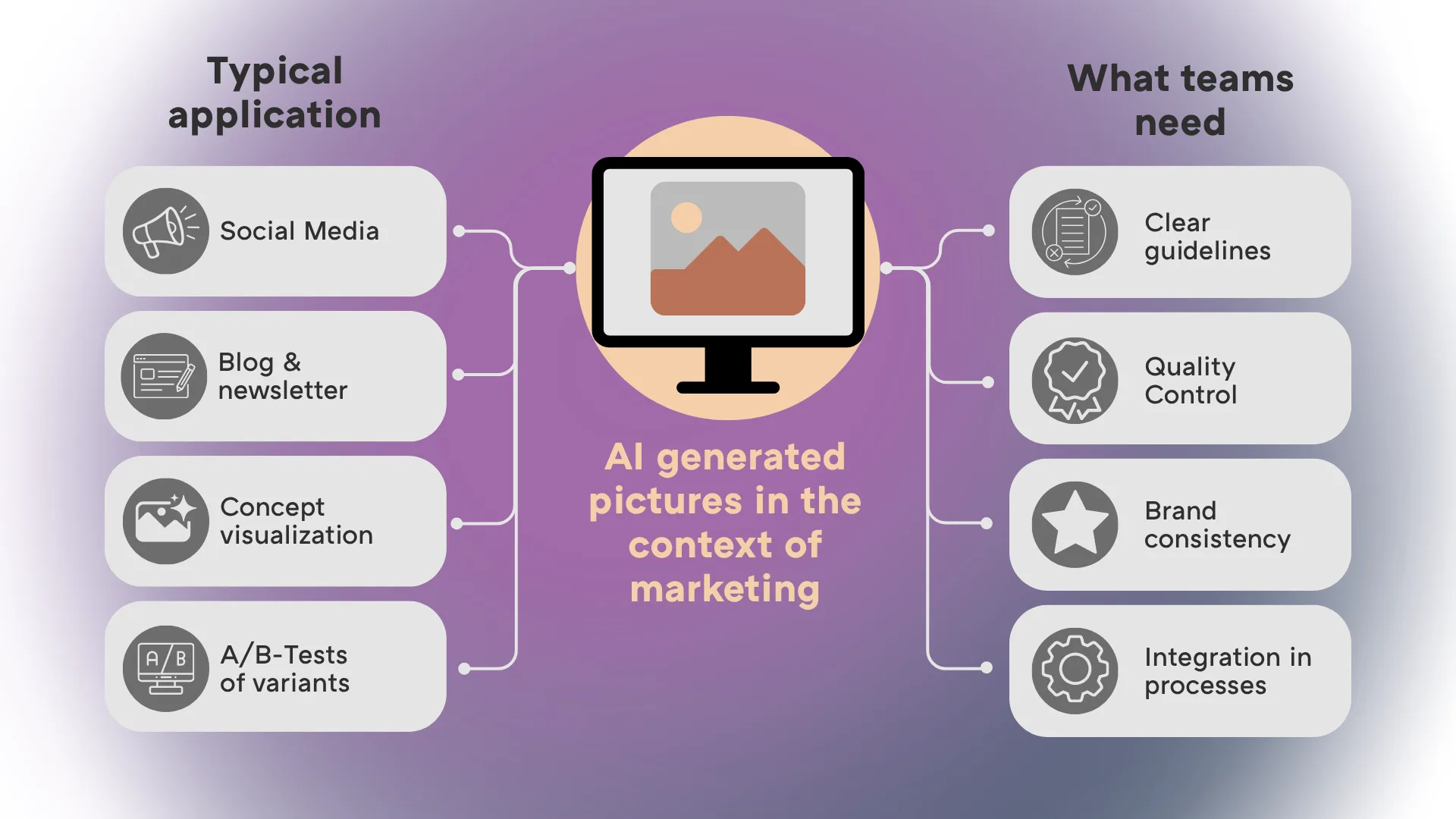
The practical value becomes clear in concrete marketing applications when you create images with AI. Social media content, blog illustrations, and newsletter headers can be produced quickly and cost-effectively. Concept visualizations for campaign pitches are created in minutes instead of days. A/B testing of different visual approaches becomes practical thanks to the rapid production of variants.
However, integrating AI into your marketing processes requires more than technical access: you need clear guidelines on when AI image creation is appropriate, how quality control works, and how to ensure brand consistency. Teams that successfully generate AI images treat them as a complement to existing visual resources.
Social Media Content with AI Visuals
Social media platforms are the ideal field of application for AI-generated images. The requirements play to the strengths of the technology: fast production, high frequency, visual variety. Create background images for quotes, illustrate tips and insights, produce themed visuals for campaigns. The lower resolution requirements compared to print media make minor inaccuracies less critical. Develop prompt templates for recurring content formats: your team can then consistently create images with AI without starting from scratch every time. Pay attention to platform-specific requirements: square formats for Instagram, portrait format for Stories, landscape format for LinkedIn. Test different visual styles to find out what resonates with your target audience. The ability to work with AI images makes this experimentation cost-effective.
Ensuring Brand Consistency in AI-Generated Images
Brand consistency doesn’t happen automatically. It requires a systematic approach. Define visual parameters for your brand: preferred color palettes, lighting moods, image compositions, and stylistic directions. Integrate these into standardized prompt templates. Build a reference library of successful AI-generated image examples that meet your brand standards, including the prompts used. Over time, this will help you build a consistent visual vocabulary.
Implement a review process: not every generated image should be published directly. Check for brand compliance, visual quality, and appropriateness for the context. Train your team in the defined standards. Consistency requires a shared understanding. Treat AI images as part of your brand guidelines.
Workflows for Integration into Existing Processes
Successful integration starts with identifying suitable use cases in your existing workflows. Analyze where you regularly need visuals that are conceptual and do not require absolute precision.
Establish a standardized process: briefing, prompt development, generation, review, post-editing if necessary. Assign responsibilities: who writes the prompts, who reviews the results, who gives final approval? Document successful prompts and best practices in an accessible repository. Measure efficiency gains: time and cost savings compared to previous methods.
Decision Guide: When Is AI Image Generation Worthwhile for Your Business?
Being able to create images with AI pays off if you regularly need conceptual visuals, want to increase your content frequency, or face budget constraints for visual resources. You will benefit most if your marketing focuses on social media, blogs, or digital channels, where speed and variability matter more than absolute perfection.
The technology is less suitable if your brand relies on precise product depictions, you primarily serve print media, or absolute visual consistency across all touchpoints is critical. Start with a limited pilot project: choose a specific use case, test systematically, and measure the results. Evaluate after three months: Have you achieved measurable efficiency gains? Does the quality meet your standards? Does your target audience accept the visuals?
This data-driven assessment will show you whether and how you should scale your use of AI image generation. Many teams use AI images selectively for specific content types while sticking with proven methods for other applications.


.jpg)
.png)