Which AI Systems Can Actually Be Optimized?
The digital landscape is changing: generative AI applications such as ChatGPT, Claude, or Perplexity could soon take significant market share from traditional search engines. For businesses, the crucial question is: How do we stay visible when users no longer get their information only from search engines, but directly from AI-powered answer engines?
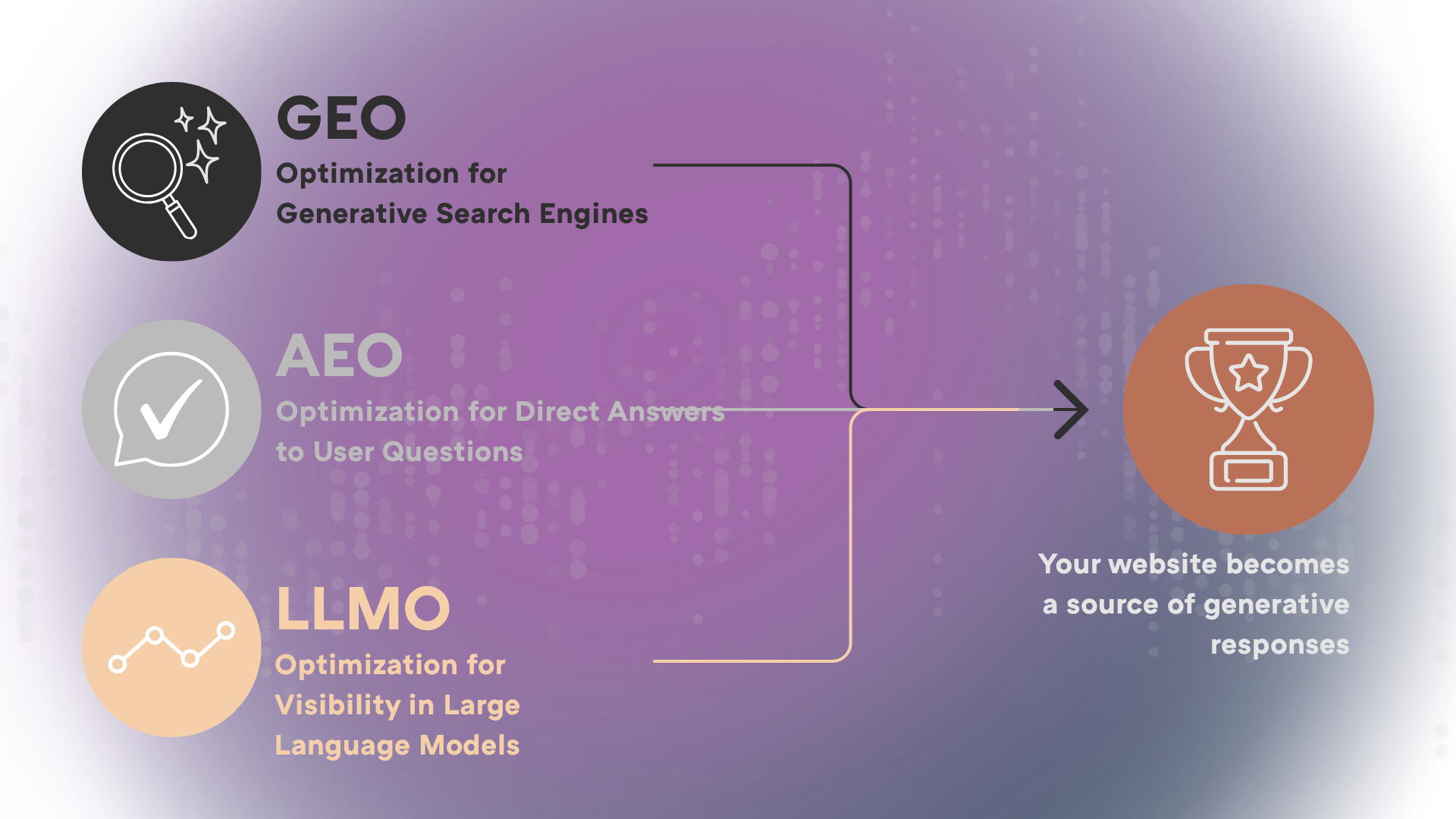
The terms Large Language Model Optimization (LLMO), Generative Engine Optimization (GEO), and Answer Engine Optimization (AEO) address exactly this challenge – they describe the logical evolution of SEO in the age of generative AI. LLMO refers to optimization for large language models as a whole, GEO focuses on optimization for generative AI search systems, and AEO describes targeted optimization for direct answers – for example in AI Overviews or featured snippets. In our experience, the three disciplines overlap to a very large extent in practice: the levers are largely identical; the difference lies in the final format of the answer.
Before we discuss the relationship between SEO and AI visibility, one fundamental distinction needs to be made – because not every AI system can be influenced to the same degree.
Technically speaking, AI systems work in two very different ways:
Classic large language models (LLMs) without web access generate answers exclusively from their training data. Their knowledge is "frozen" at a fixed knowledge cutoff. They do not actively access the web, but generate answers based on the statistical patterns they learned during training. Example: ChatGPT in classic mode without web search enabled, or Claude without tool use. Here, classic SEO measures do not help in the short term – the content would already have had to be part of the dataset in an earlier training phase in order to be reproduced.
RAG systems with grounding (retrieval-augmented generation), by contrast, combine a language model with a live web search. They break the user query down into multiple sub-queries, retrieve current web content, and use it as the basis for the generated answer. This category includes Google AI Overviews, Google Gemini with Search, ChatGPT Search, Perplexity, and Microsoft Copilot. These systems can be actively influenced by SEO measures – because they access exactly the content that is also indexed in classic search engines.
This distinction is crucial: All statements about the relationship between SEO and AI visibility refer to RAG systems with grounding functionality. For pure LLMs without web access, the influence runs through a different, much slower channel – namely whether and how your content and your brand are included in the dataset during the next model training. This lever works through brand awareness, consistent mentions on authoritative platforms, and topical presence on the web – not through short-term SEO measures.
The good news: Virtually all AI systems currently gaining relevant market share now use grounding. Google AI Overviews and AI Mode are retrieval-based, Perplexity has been designed retrieval-first from the outset, and ChatGPT automatically activates web search for current or specific questions. This means: The most relevant lever for AI visibility today is in fact exactly what classic SEO has always addressed.
The Key Insight: Grounding-Based AI Systems Preferentially Cite What Is Already Visible in Search Engines
For RAG systems with grounding, the question "Is AI visibility linked to classic SEO visibility?" can be answered empirically – and the answer is yes. The correlation varies by platform, but it is measurable:
Google AI Overviews: An Ahrefs analysis of 1.9 million AIO citations found that 76 percent of cited pages rank in Google's top 10. Over a period of 16 months, BrightEdge documented that the overlap between AIO sources and organic rankings overall grew from 32 to 54 percent – and in YMYL sectors even to 68 to 75 percent (healthcare 75.3%, education 72.6%, insurance 68.6%), while e-commerce remained virtually unchanged at 22.9 percent. An important point of context: this figure measures the overlap with organic rankings overall, i.e., including positions 11 to 100. Only around 17 percent of citations come from the top 10 for the same query.
Perplexity: A 2024 BrightEdge analysis found a 60 percent overlap between Perplexity citations and Google's top 10, and as much as 82 percent in the healthcare sector. More recent data from Ahrefs (15,000 prompts, July 2025) is significantly lower at around 29 percent – so while Perplexity remains the platform most closely aligned with Google, the relationship has weakened here as well.
ChatGPT with web search enabled: An SE Ranking analysis of 129,000 domains and 216,524 pages identified the number of referring domains as the strongest single factor: sites with up to 2,500 referring domains receive an average of 1.6 to 1.8 ChatGPT citations, while sites with more than 350,000 referring domains reach 8.4 citations. A smaller study by Seer Interactive (500+ citations, February 2025) found an 87 percent overlap with Bing's top results in active browsing mode. This figure should be treated with caution: it is based on a much smaller sample, and there are indications that ChatGPT has since shifted its retrieval sources.
The logic behind this is simple: A RAG system runs a search query in the background, evaluates the results, and uses them as the basis for the generated answer. Whether a human or an AI performs this search, the mechanisms of source selection are based on the same fundamental principles: relevance, authority, trust, and clear structure. Being present in search engines measurably increases the likelihood of also being cited in the AI answers of these grounding-based systems.
But: The Weighting of SEO Disciplines Is Shifting
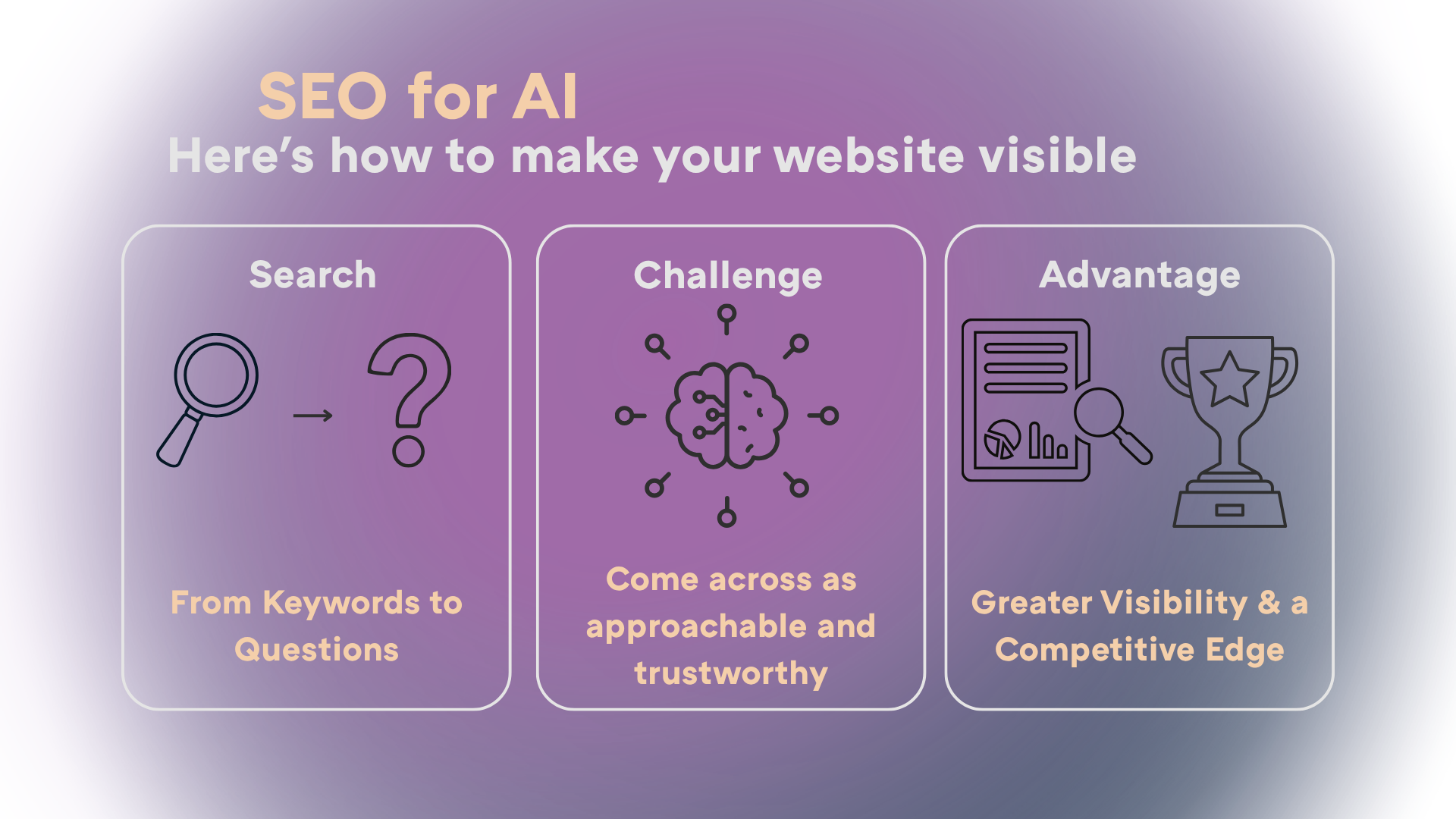
This is where things get more nuanced. While the relationship between SEO visibility and AI citation is well documented, the relative importance of individual levers within the classic SEO stack is shifting. Three observations are key:
1. The overlap between top 10 rankings and AIO citations is declining
A follow-up Ahrefs study (863,000 keywords, 4 million AIO URLs, February 2026) shows that the share of AIO citations from Google's top 10 has fallen from 76 percent (July 2025) to 38 percent. The remaining citations are spread almost evenly between positions 11 to 100 (31.2%) and pages beyond position 100 (31.0%). Ahrefs itself points out that part of this decline is due to improved citation detection in its own tooling – so the two datasets are not directly comparable. The direction of the trend, however, is independently confirmed by other providers. Google is increasingly drawing on sources that do not rank on page 1 – an effect of so-called query fan-out, in which a single user query is broken down into several semantically related sub-queries. The consequence: A pure top 10 strategy for a single main keyword is no longer sufficient. Topical breadth and depth are becoming more important.
2. Brand mentions and digital authority outperform pure backlink metrics
Ahrefs analyzed 75,000 brands and found that brand mentions correlate with AIO visibility with a Spearman coefficient of 0.664, while classic backlinks show a correlation of only 0.218. This makes brand mentions roughly three times as predictive as pure link metrics. An expanded study from December 2025 confirms the pattern across all three major AI platforms: branded web mentions come in at 0.664 for AI Overviews, 0.709 for Google AI Mode, and 0.656 for ChatGPT. YouTube mentions even show the strongest single correlation (~0.737). This does not mean that backlinks have become irrelevant – they continue to have an effect via rankings, which in turn create AIO eligibility. But they are no longer the dominant lever for pure AI visibility. Brand mentions are also the lever that has a long-term effect on pure LLMs without web access – via the training data path.
3. Platforms work differently
An Ahrefs analysis of 15,000 prompts shows that only 12 percent of ChatGPT, Gemini, and Copilot citations overlap with Google's top 10. For Perplexity, the figure is around 30 percent. ChatGPT and Claude often prefer niche expert publications with topical depth (Investopedia, Wired, GitHub, Coursera, Edmunds) over generalist high-DA domains. A one-size-fits-all strategy for all platforms falls short.

The Four Pillars of SEO in the AI Era
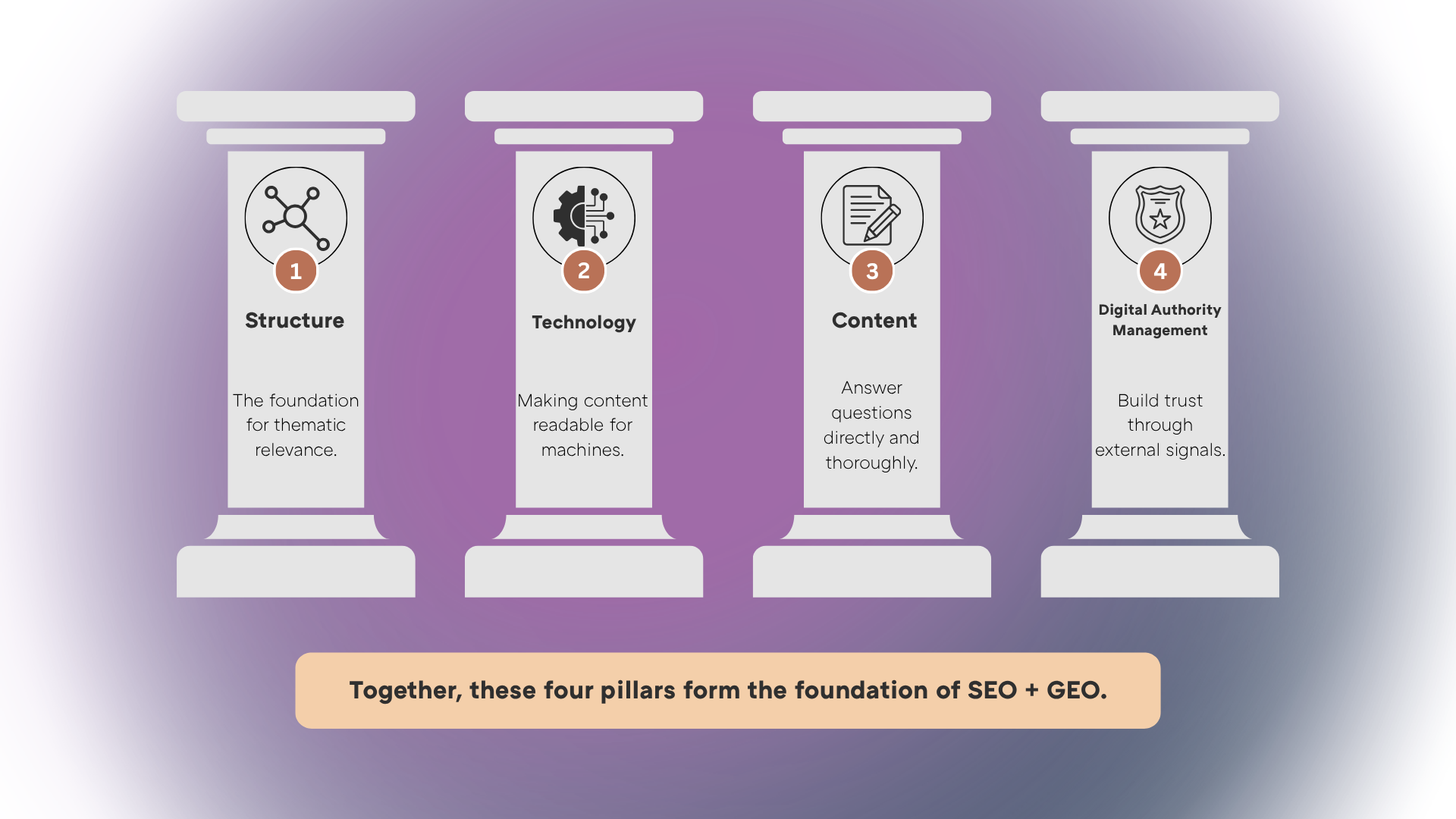
Our recommendation as an agency is not to turn away from classic SEO, but to deliberately rebalance the four core disciplines: structure, technology, content, and Digital Authority Management. These four pillars form the foundation of our SEO and GEO strategy – and they work exactly as the current body of research suggests.
Structure
Structure remains the foundation – and, since the Google API leak of May 2024, it is at least documented. The leak revealed that Google's internal Content Warehouse documentation includes attributes for topical focus: siteFocusScore (how strongly a site concentrates on a core topic), siteRadius (how far an individual page deviates from the core topic), and siteAuthority (the domain authority that Google has publicly denied for years but that is documented in the code). These signals are calculated using so-called site2vec embeddings, which map a website profile in semantic space.
The practical implication is clear: A well-thought-out URL architecture, topical segmentation (siloing), a clear navigation structure, and consistent internal linking ensure that search engines and AI systems can grasp the topical relevance and depth of a website in the first place. In its 2025 ranking factors update, First Page Sage lists "niche expertise" – defined as at least 10 authoritative pages on a shared topic cluster – as the fourth strongest factor at around 13 percent. This is an expert assessment by the agency based on its own project experience, not a correlation measurement. The effect is, however, empirically supported by a Graphite study (332 URLs, 12 domains): content on domains with high topical authority gains visibility 57 percent faster, has a 62 percent higher probability of generating traffic in the first week, and reaches impression milestones 30 percent faster. The study measures classic organic visibility, not AI citations – the connection to AI visibility arises indirectly via rankings.
Particularly in the context of query fan-out – where AI systems break a user query down into several sub-queries – topical authority across interconnected topic clusters becomes the decisive factor. A website with a clean structural setup serves not just a single keyword, but an entire semantic field.
Technology
Technology remains a must. Crawlability, indexability, loading speed, and clean sitemap structures are the prerequisite for both search engines and AI crawlers (GPTBot, OAI-SearchBot, Perplexity-Bot, Google-Extended) to be able to process content at all. Structured data via Schema.org is not a direct ranking factor – Google has confirmed this several times – but it supports machine interpretability and thus the likelihood of being cited in AI Overviews. A Search Engine Land experiment with three test pages showed that only the page with correctly implemented schema appeared in an AI Overview – with a sample size this small, this is an indication, not proof. Conversely, the SE Ranking analysis of 129,000 domains found that pages without FAQ schema actually received slightly more ChatGPT citations on average (4.2 versus 3.6). The two findings contradict each other less than it seems: Google AI Overviews work with the index and the Knowledge Graph and can evaluate markup, whereas ChatGPT accesses visible page content. For Google's systems, schema therefore remains useful; for pure retrieval engines, it is not a lever.
Content
Content remains central, but its format is shifting. AI systems prefer so-called answer-first structures: the direct answer to a question appears in the first 1–2 sentences of a section, followed by context and evidence. An analysis by Kevin Indig showed that 44.2 percent of all citations come from the first 30 percent of a text, 31.1 percent from the middle, and only 24.7 percent from the final third (the "ski ramp distribution"). The analysis is based on 18,012 verified citations, isolated from a dataset of around 1.2 million ChatGPT responses and traced back to their respective source sentences using sentence transformer embeddings. Concrete figures, data, and source references measurably increase the likelihood of being cited: The Princeton GEO paper (Aggarwal et al., KDD 2024) tested nine optimization methods across 10,000 queries. The three most effective – adding source citations, incorporating quotations, and integrating statistics – each achieved a relative improvement of 30 to 40 percent on the position-adjusted word count metric and 15 to 30 percent on the subjective impression metric. Keyword stuffing, by contrast, had no effect whatsoever. The study tested a simulated generative engine based on GPT-3.5; the order of magnitude is transferable, while the exact values apply to the system at the time. In addition to classic keyword research, prompt research is also gaining importance: What questions do users ask AI chatbots? What sub-queries result from them? These insights feed directly into the content strategy.
Digital Authority Management
Digital Authority Management is becoming the most important discipline in the AI era – and at the same time the only lever that works across both paths: via grounding in retrieval-based systems and via training data in pure LLMs. Digital Authority Management encompasses far more than classic link building. It is about the targeted building of digital authority through:
- High-quality backlinks from directories, chambers of commerce, guest articles, specialist blogs, and forums
- Citations and brand mentions in trade articles, studies, and relevant industry media – they strengthen trust and E-E-A-T signals
- Linkable assets such as white papers, infographics, tools, or original data, which AI systems preferentially use as references
- Multi-platform presence on Reddit, LinkedIn, YouTube, G2, Capterra, Trustpilot, and topical expert publications
The data supports this: The SE Ranking analysis of 129,000 domains shows that brands with a strong discussion presence on Reddit and Quora receive around four times as many ChatGPT citations as brands that are rarely mentioned. Domains with profiles on review platforms such as Trustpilot, G2, or Capterra are roughly three times as likely to be cited. A Stacker study (215 stories, 75 brands, 8 AI platforms, January to March 2026) shows a clear relationship between Domain Rating and citation rate: pickups by publishers in the DR 81 cluster were cited in AI answers in 43 percent of cases, pickups from the DR 62 cluster in only 2 percent. However, the correlation of r=0.99 reported by Stacker refers to the averages of just four publisher clusters, not to the individual stories – the direction is robust, but the strength of the correlation should not be overinterpreted. Quality beats quantity more clearly than ever. The latest Muck Rack analysis (May 2026) evaluated more than 25 million links cited by ChatGPT, Claude, and Gemini across 17 industries: 84 percent of all AI citations come from earned media – i.e., from journalism, research, government and encyclopedic sources, and third-party content. Paid and advertorial content accounts for 0.3 percent. Across all three editions of the study since July 2025, this figure has remained stable at between 82 and 89 percent.
Our Agency Position: An Integrated Strategy Instead of a Buzzword Discipline
In practice, we see two common mistakes:
The first is declaring classic SEO obsolete and reinventing "GEO" as an isolated discipline with its own secret hacks. That sells well, but it ignores the documented data: the correlation between organic visibility and AI citation in retrieval-based systems is real and in some cases very strong.
The second mistake is the opposite: continuing to define pure top 10 rankings for individual keywords as the KPI and ignoring the structural shift. The correlation exists, but it is weakening. Anyone who still claims in 2026 that "good SEO is enough" is overlooking the demonstrable shift toward brand mentions, topical depth, and multi-platform presence – and is also underestimating the share of pure LLM usage that is not served via grounding.
Our position is neither. We treat SEO and AI visibility as an integrated strategy with clearly weighted levers: a solid structural and technical foundation, answer-optimized content with topical depth, targeted Digital Authority Management via backlinks, citations, and brand mentions, and platform-specific optimization wherever it demonstrably makes a difference.
It is not the fastest approach – but it is the one that holds up against current research.

What Google Officially Clarified on May 15, 2026
Since mid-May 2026, this assessment is no longer just our view, but also Google's official position. On May 15, 2026, Google published "Optimizing your website for generative AI features on Google Search," its first canonical guide to optimizing for AI Overviews and AI Mode. The key statement reads verbatim: "From Google Search's perspective, optimizing for generative AI search is optimizing for the search experience, and thus still SEO."
The guide includes a dedicated "mythbusting" section in which Google explicitly declares five popular GEO tactics irrelevant: separate llms.txt files, breaking content into bite-sized pieces ("chunking"), rewriting content specifically for AI readability, buying staged brand mentions, and an obsession with schema without any discernible benefit. An Ahrefs study from June 2026 backs this up with clear figures: of 137,210 domains examined, 28 percent had an llms.txt file in place – and 97 percent of these files did not receive a single request in May 2026. For the remaining three percent, only around 1.1 percent of requests came from AI retrieval bots; the rest came mainly from SEO audit tools.
For us as an agency, this official clarification is a welcome confirmation – and at the same time an important differentiator. We don't sell GEO hacks, because the data speaks against them. What we do is exactly what Google's own recommendations actively support: unique, experience-based content, clean structure and technology, and the targeted building of digital authority through authentic third-party coverage. It is precisely these four pillars – structure, technology, content, and Digital Authority Management – that form the foundation of our SEO/GEO roadmap.
Platform-specific differentiation remains important: Google's guide refers explicitly to its own surfaces (AI Overviews, AI Mode). Similar basic principles apply to ChatGPT, Perplexity, and Claude, but the requirements are not identical. Independent studies on these platforms point in the same direction, but are not yet conclusively canonical. Serious GEO consulting recognizes this difference – and does not sell universal hacks where platform-specific analysis is needed.
Fine-Tuning for AI Search
The following measures are derived from the studies cited above. They are additive and exploratory: the data shows correlations, not causation. What makes sense in any individual case depends on industry, competition, and objectives, and should be coordinated with your SEO team. SE Ranking itself points out that the factors are interdependent – over-optimizing a single one while ignoring the others worsens the overall result.
Accessibility for AI systems
Check whether AI crawlers can get through to you. Allow GPTBot, OAI-SearchBot, PerplexityBot, ClaudeBot, and Google-Extended in your robots.txt – and then check in your server logs whether the requests are actually answered with a 200 status code. The Otterly AI Citations Report (February 2026), which evaluated more than one million citations, found that 73 percent of sites had technical barriers to access by AI crawlers – mostly robots.txt rules, CDN configurations, or JavaScript rendering. The most common cause is rules that nobody deliberately set up for AI crawlers.
Check the source code, not the rendered page. A joint study by Vercel and MERJ (December 2024) found no evidence that the major AI crawlers execute JavaScript. GPTBot fetches JavaScript files in 11.50 percent of requests, ClaudeBot in 23.84 percent – neither of them executes it. Among the major crawlers, only Googlebot renders JavaScript – and with it Google Gemini. The simplest test: open the page, view the source code, and search for a sentence from the main content. If it isn't there, these systems can't see it.
Page structure
Put the answer first. 44.2 percent of all citations come from the first 30 percent of a text, 31.1 percent from the middle, and only 24.7 percent from the final third. The direct answer belongs in the first one to two sentences of a section.
Don't write mini-sections. In the SE Ranking analysis, sections of 120 to 180 words between two headings received an average of 4.6 citations, while very short sections under 50 words received only 2.7. Sections over 180 words performed even slightly better at 5.7 – SE Ranking attributes this to more comprehensive topic coverage. The robust finding is therefore: not too short. The widely promoted practice of chopping content into tiny pieces is counterproductive according to this data – and Google advises against it in its own guide anyway.
Writing style
Include statistics. Pages with 19 or more data points received an average of 5.4 citations, pages with minimal data density 2.8.
Include expert quotes. Pages with quotes from named experts received 4.1 citations, pages without 2.4.
Cite sources. The Princeton GEO paper identified source citations, quotations, and statistics as the three most effective of the nine methods tested, each with a relative improvement of 30 to 40 percent.
Important context: SE Ranking rates the effect of statistics and quotes as comparatively small relative to factors such as authority or traffic. They are indicators of content quality, not a standalone lever.
Write clearly. In the analysis of verified citations, cited content scored well below the level of lower-performing content on the readability measure. Shorter sentences and simple sentence structures beat dense technical prose. Keyword stuffing, on the other hand, had no effect in the Princeton paper and performed slightly negatively on Perplexity.
Topic coverage
Think in sub-questions rather than keywords. In the AirOps analysis of 548,534 retrieved pages, 32.9 percent of all cited pages came exclusively from the results of the sub-questions – they were never found via the original user query. 89.6 percent of the queries analyzed triggered at least two sub-questions.
Avoid over-optimized titles and URLs. One of the most surprising findings of the SE Ranking analysis: titles with a very high semantic match to the target keyword received an average of 2.8 citations, broadly phrased titles 5.9. The same pattern emerges for URLs. A title that describes the topic beats one that has been optimized for a keyword.
Substance beats brevity. Content with more than 2,900 words received an average of 5.1 citations, thin content under 800 words 3.2.
Freshness
Maintain your existing content. Content updated within the last three months received an average of 6.0 citations, outdated content 3.6. Notably, age alone plays hardly any role – brand-new content received 3.6, content one to five years old 3.1. What matters is maintenance, not the publication date.
Presence beyond your own website
Review and comparison platforms. Domains with profiles on Trustpilot, G2, Capterra, Sitejabber, or Yelp achieved 4.6 to 6.3 citations, domains without such profiles 1.8.
Specialist communities. On Quora, the range extends from 1.7 citations with minimal presence to 7.0 with very high presence; on Reddit, from 1.8 to 7.0. The upper end, however, is measured in millions of mentions – not an achievable goal for mid-sized brands, but it does indicate the direction.
YouTube. In December 2025, Ahrefs identified brand mentions on YouTube as the strongest single correlation across all three major AI platforms.
Editorial coverage. According to the Muck Rack analysis of more than 25 million cited links, 84 percent come from sources the brand does not own.
Measurement
Change your KPIs. Ranking positions alone no longer reflect AI visibility. Meaningful metrics include share of mentions within a topic area, the frequency of brand mentions, and their sentiment. Server log analysis also helps: Which AI crawlers access which pages, and with which status code?
Conclusion: SEO Remains the Foundation – but the Weighting Is Shifting
The shift toward AI-powered search is not a short-term change. Visibility no longer comes exclusively from classic rankings, but additionally from the likelihood of being cited as a source in generated answers. The good news: For all relevant AI systems with grounding functionality, this likelihood is demonstrably linked to classic SEO visibility.
Companies that keep SEO as their foundation while also investing in Digital Authority Management, topical depth, and platform-specific presence can secure decisive competitive advantages. KITICON supports companies on this journey – with an integrated strategy of structure, technology, content, and Digital Authority Management that relies on verifiable data rather than buzzwords.


.jpg)