KI Reiseplanung: Wie KI-Reiseagenten den Tourismus verändern
AI plans the trip – but will it book it too?
AI has already become an established tool for inspiration, research, and travel planning. When it comes to the final booking decision, however, trust, transparency, and human advice still matter.
The future of travel planning? Not humans or AI – but both.
AI in Travel Planning: How AI Travel Agents Are Transforming Tourism
Where should the next trip go? Which hotel truly matches your personal preferences? And how can flights, activities, and accommodation be combined as easily as possible? When faced with questions like these, travelers no longer rely exclusively on Google, booking platforms, or tour operator websites. Increasingly, they are also turning to artificial intelligence. AI systems can suggest destinations, compare offers, create itineraries, and, in theory, even accompany travelers all the way through to booking. This development goes far beyond a short-lived technology trend. AI is beginning to change the way people search for, compare, and plan trips. At the same time, there is still a significant difference between receiving a useful AI recommendation and handing over the entire booking process to a digital agent. A recent ReiseZukunft study conducted by CENTOURIS at the University of Passau shows where travelers currently stand — and what opportunities this creates for tour operators, travel agencies, hotels, and destinations.
AI Travel Planning: From Search Box to Personal Travel Assistant
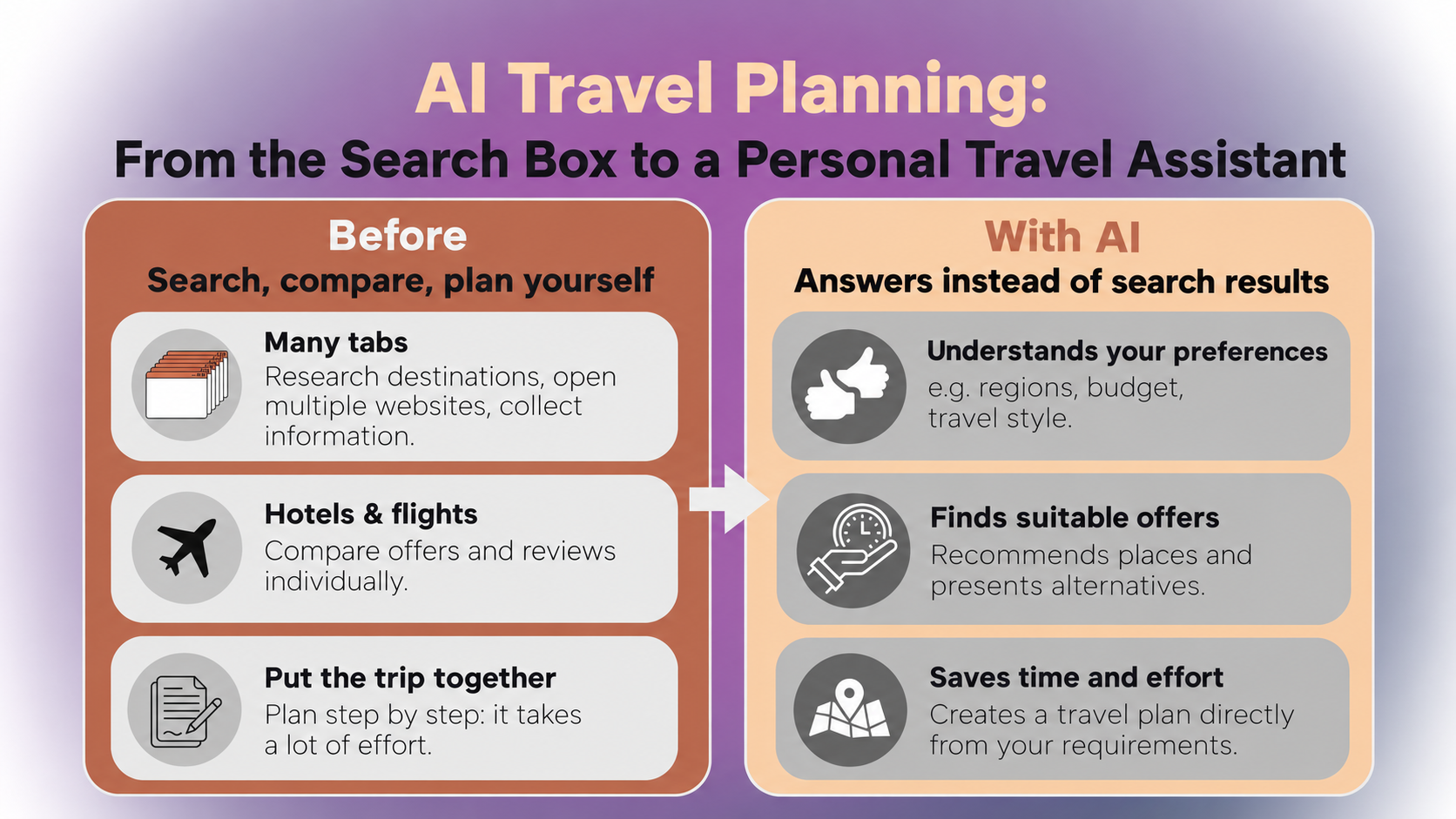
For many years, travel planning was heavily driven by search engines. Travelers searched for destinations, opened multiple tabs, compared hotels and flights, read reviews, and gradually pieced together their trip. Generative AI is changing this process. Instead of searching, for example, for “beautiful destinations in Italy in September” and then browsing numerous websites, users can now formulate a much more detailed request:
“I would like to spend seven days in Italy in September. I am looking for a quiet coastal region, do not want to rent a car, and would prefer a small hotel with excellent regional cuisine. Which destinations would suit me?”
An AI travel assistant can use these requirements to generate recommendations, compare alternatives, and develop a travel itinerary. According to respondents, such an assistant should primarily understand personal preferences, save time and effort, identify suitable offers, and ideally support travelers across multiple stages of their journey. This means that it is not only the research tool itself that is changing. Expectations of digital travel advice are changing as well: users increasingly want to spend less time searching and receive more curated, personalized answers.
How Widely Is AI Already Being Used for Travel Planning?
Google and traditional booking platforms continue to dominate travel planning. 62% of respondents use Google Search, 59% use online booking platforms, and 48% obtain information directly from the websites of hotels, airlines, or other providers. One finding is particularly noteworthy: 23% already name AI chats such as ChatGPT as a typical source of information when planning a trip. In the study, this puts AI slightly ahead of social media at 21% and traditional travel agencies as a source of information at 19%.
The trend becomes even more apparent when looking at younger target groups. Among Generation Z, 35% already use AI chats as a source of travel information, compared with 31% of Generation Y. The figure falls to 17% for Generation X and 10% for baby boomers. This does not mean that Google or booking platforms will disappear anytime soon. What it does show, however, is that an additional route into the travel decision-making process is emerging — and this route works differently from traditional search.
When AI Changes Search Behavior
The picture becomes particularly interesting among people whose search or booking behavior has already changed as a result of AI. Of this group, 48% say they search less frequently via Google. 44% say they make decisions more quickly. 27% visit provider websites less often, while 26% use travel agencies less frequently.
For tourism companies, this raises a crucial question:
What happens when the first point of contact with a destination, hotel, or tour operator no longer takes place on the company’s own website or via Google, but within an AI system?
Alongside traditional SEO, another issue is therefore becoming increasingly important: whether information is available online in a sufficiently clear, up-to-date, and structured format for AI systems to interpret it reliably.
Quote from Bettina Zwickler:
“Opening ten different websites just to get an overview is precisely what many travelers no longer want to do. If AI can pre-sort relevant information and reduce a large number of options to a manageable selection, that initially represents a major gain in convenience. For providers, however, this creates a new challenge: they need to remain visible and easy to understand even when the customer’s first point of contact no longer takes place on their own website.”
What Do Travelers Use AI Travel Assistants For?
At present, the main focus is still clearly on support and guidance rather than fully autonomous booking. 40% of respondents have already used AI travel assistants for inspiration or travel ideas, and the same proportion have used them to search for information. 34% use them for itinerary or trip planning, while another 34% use them to compare offers. 26% use AI to support booking decisions, while 21% use it for direct assistance during the booking process. By contrast, only 11% have booked directly through an AI assistant.
During a trip — for example, for recommendations or translations — 35% have already used AI support. This points to an interesting pattern: the closer AI comes to carrying out a binding transaction, the more cautious many travelers become. The barrier to using AI for inspiration is low. Asking an AI for a hidden gem in Lisbon feels considerably less risky than entrusting it with credit card details and allowing it to independently book a trip worth several thousand euros.
Trust Will Determine the Future of AI Travel Agents
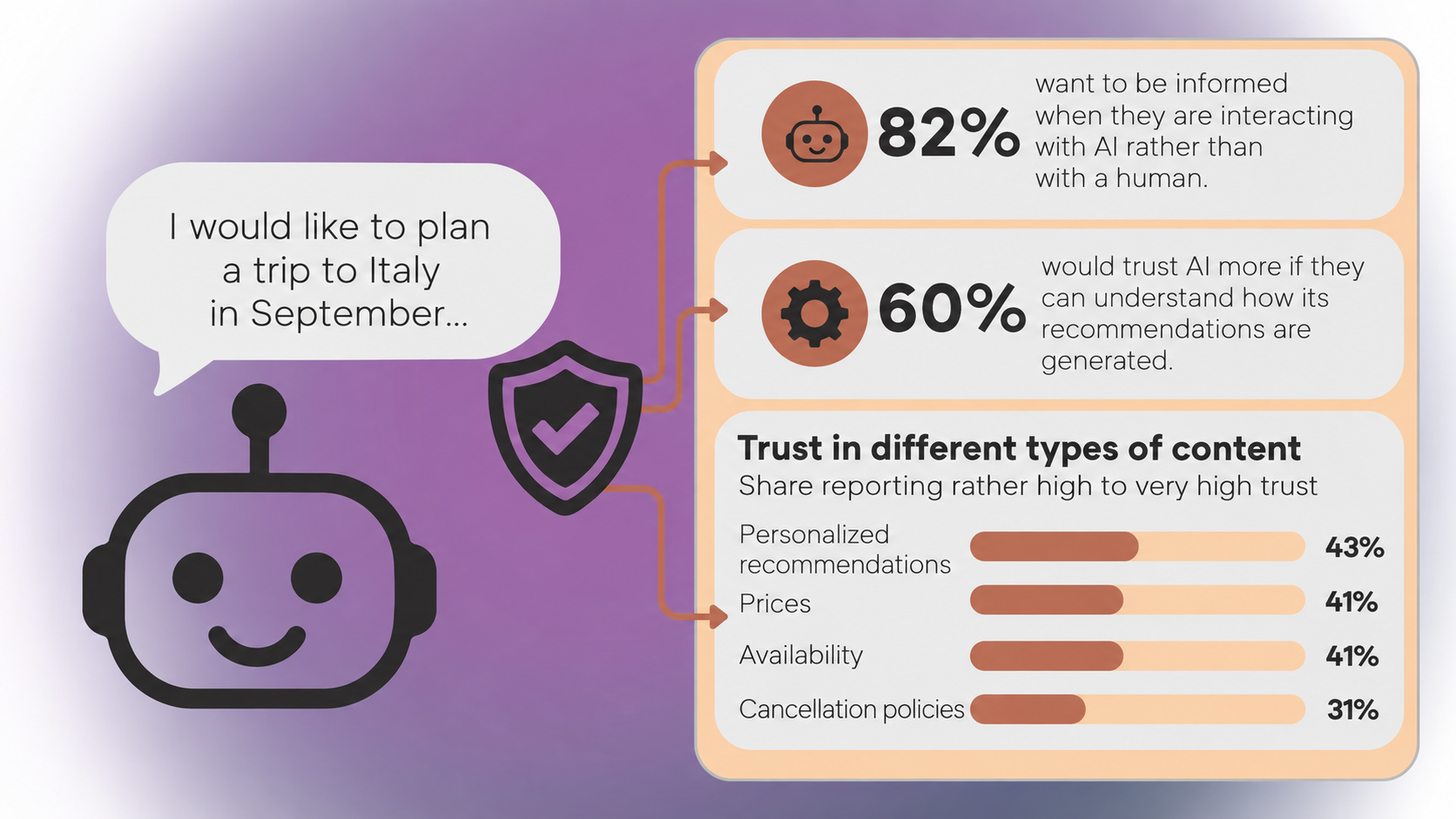
Technical capabilities alone are not enough. Travelers need to understand who — or what — they are interacting with and why certain recommendations are being made. 82% want to be informed when they are interacting with AI rather than a human. 60% say they would trust AI more if they could understand how its recommendations were generated. Trust also varies depending on the type of information being provided. 43% of respondents report fairly high to very high trust in AI travel assistants when it comes to personalized recommendations, while 41% say the same about prices and availability. For cancellation policies, however, this figure drops to 31%. In other words, the more binding and consequential a piece of information becomes, the more important reliability and safeguards are.
Commissions and Paid Placements Are Becoming a Question of Trust
This becomes particularly clear when commercial interests are involved. Concerns that paid placements or commissions could influence AI recommendations are present across all generations: 68% of Generation Z, 61% of Generation Y, 62% of Generation X, and 67% of baby boomers share this concern.
For tourism providers and platforms, this is an important signal. If AI systems play an increasingly influential role in travel decisions in the future, travelers will need transparency about why an offer is being recommended and which commercial relationships may be behind it.
Quote from Bettina Zwickler:
“Travel can quickly involve a significant amount of money as well as the most valuable time of the year. Convenience alone is not enough when it comes to AI. Customers need to understand why a particular hotel or trip is being recommended to them. As soon as people get the impression that commissions are influencing recommendations more strongly than their own needs, trust quickly becomes the decisive issue.”
Why AI Could Ruin a Holiday: Everyone May End Up Seeing the Same Things
AI can make travel planning easier, faster, and more personalized. At the same time, this creates a new problem: if more and more travelers ask the same AI systems for destinations, hotels, restaurants, or activities, those systems may increasingly produce the same recommendations. Already today, around one in four holidaymakers uses AI to suggest travel destinations. A further 41% can imagine doing so.
As usage increases, so does the risk that certain places will become disproportionately visible while others barely appear at all. Supposed hidden gems could quickly become overcrowded destinations.
After all, AI does not simply organize information; it also influences which offers travelers discover in the first place. The challenge will therefore be to avoid confusing personalization with standardization. Otherwise, a technology that promises more individual travel experiences could ultimately lead to everyone experiencing the same things.
No items found.
Human or Machine? Travel Advice Needs Both
Perhaps the most interesting finding of the study is not that AI could replace human travel advice, but that many travelers appear to find a combination of technology and human reassurance attractive. 62% say they would be more likely to use AI agents if they could access human support at any time. 53% would be more willing to use them if a travel agency or provider additionally verified recommendations and bookings. 54% prefer human approval before an AI actually completes a booking. This points toward a hybrid model: AI takes over tasks where speed, data processing, and personalization offer clear advantages, while people step in where advice, judgment, responsibility, or reassurance become particularly important.
This could represent a major opportunity for travel agencies and tour operators.
Quote from Bettina Zwickler:
“For me, AI is not an alternative to personal travel advice, but a complement to it. When technology takes over routine tasks and brings information together more quickly, there is more time for what good advice is really about — understanding needs, putting experiences into context, and providing reassurance when a trip becomes more complex.”
Will AI Replace the Travel Agency?
Current developments point less toward a simple either-or scenario and more toward a redistribution of responsibilities. AI can process large volumes of information within seconds, compare offers, and generate personalized suggestions. People, by contrast, can interpret situations, ask follow-up questions, deal with uncertainty, and take responsibility.
This human dimension is likely to remain important, particularly for more complex trips, problems, or high-value bookings. At the same time, travel agencies should not view AI purely as competition. Those that intelligently integrate AI into their own advisory processes could automate part of their research and routine work while focusing personal consultation more strongly on the moments when it creates the greatest value for customers.
Conclusion: AI Is Changing Not Only Travel Planning, but Also the Role of Travel Providers
AI travel assistants will not replace Google, booking platforms, travel agencies, and personal advice overnight. But they are already changing the way travelers find information and prepare their decisions. For inspiration, research, travel planning, and offer comparison in particular, AI has already become a viable option for many users. The step toward fully autonomous booking, however, is considerably larger.
Trust, transparency, data protection, and the option of human support will determine how quickly AI agents are able to take this next step. For tourism companies, this creates an important task: rather than simply asking whether AI should be used in travel distribution, they need to identify where it creates genuine added value and where people should continue to play the decisive role.
Companies that manage this interface effectively will not only create more efficient processes. They can also develop a new form of travel advice in which technology and personal expertise work together.
Source Note for the Blog
The figures used in this article are taken from the study “Zwischen Klick und Koffer – Wie viel KI akzeptieren Reisende?” (“Between Click and Suitcase – How Much AI Are Travelers Willing to Accept?”) by ReiseZukunft/CENTOURIS at the University of Passau, as of July 2, 2026.
The study is based on a population-representative, weighted online survey of 1,500 German-speaking people aged 18 and over who travel on average at least once a year.
What does AI-based travel planning mean for hotels, tour operators, and destinations?
Providers increasingly need to expect AI systems to act as intermediaries between them and potential guests. Structured and up-to-date information, transparent offers, clearly communicated services, and a combination of digital and personal contact options are therefore becoming increasingly important.
What data would travelers be willing to provide to an AI travel agent?
Willingness varies significantly depending on the type of data involved. Travel history and calendar data are more readily accepted than payment or banking information. At the same time, users want extensive control over which data is stored or deleted and which information is shared with partners.
How important is trust in AI travel agents?
Trust is one of the key requirements. 82% of respondents want to be able to recognize when they are interacting with AI. 60% say they trust AI more when they can understand how a recommendation was generated.
Will AI travel agents replace travel agencies?
Current findings point more strongly toward hybrid models. 62% of respondents say they would be more likely to use AI agents if they could access human support when needed. Additional safeguards provided by travel agencies or other providers, as well as human approval of bookings, also increase willingness to use AI.
How is AI currently being used for travel planning?
The most important use cases include inspiration and travel ideas, information searches, trip and itinerary planning, and offer comparisons. In the underlying study, 40% of respondents had used AI travel assistants for inspiration and 40% for information searches. 34% had used them for itinerary planning and 34% for comparing offers. Direct booking through an AI assistant, by contrast, stood at 11%.
What is an AI travel assistant?
An AI travel assistant is a digital application that supports travelers with inspiration, research, and trip planning. Depending on its functionality, it can recommend destinations, research information, create itineraries, compare offers, and assist with booking decisions. More advanced AI agents may also be able to independently carry out actions such as bookings in the future.
Greater visibility and more direct bookings.
As a specialized tourism marketing agency, we help hotels, destinations, tour operators, and tourism businesses increase their digital brand visibility and reach more potential guests. We combine well-founded strategies with emotional storytelling, data-driven performance marketing, and innovative AI solutions.